AI that has to show its work.
You are the one who signs the return. So the useful question is not how clever the model is — it is what happens when it is wrong, and whether you can tell.
In LedgerOS the model reads, drafts and proposes. It never gets the last word on where a document goes, what a citation says, or what a number should be.
Every citation is fetched, read, and checked against the claim it supports
A general chatbot will produce a citation that looks right. That is the failure mode, and it is the one that ends up in front of a reviewer. So the answer here is assembled only from an allow-list of federal and state authority — held in the product, scoped to the jurisdictions you picked — and then a second pass goes back out, re-fetches each source it cited, pulls the relevant passage, and checks whether that text actually supports the sentence it was attached to.
Each citation then carries the result of that check: verified when we read the source and it holds, unverified when we could not and you should confirm it yourself, and unfetched when it has not been read yet. An answer is allowed to be uncertain in public.
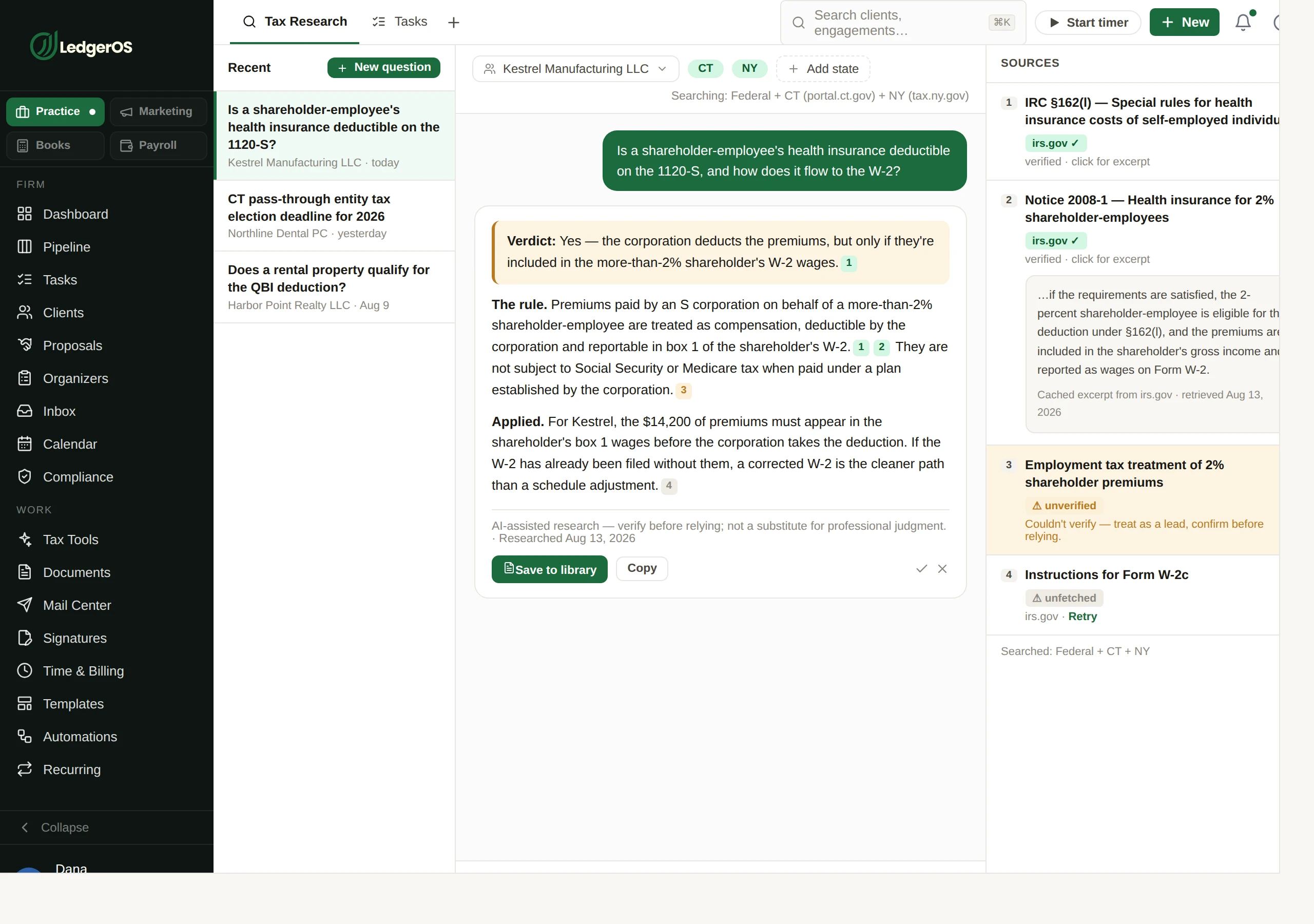
Walk through a real answer
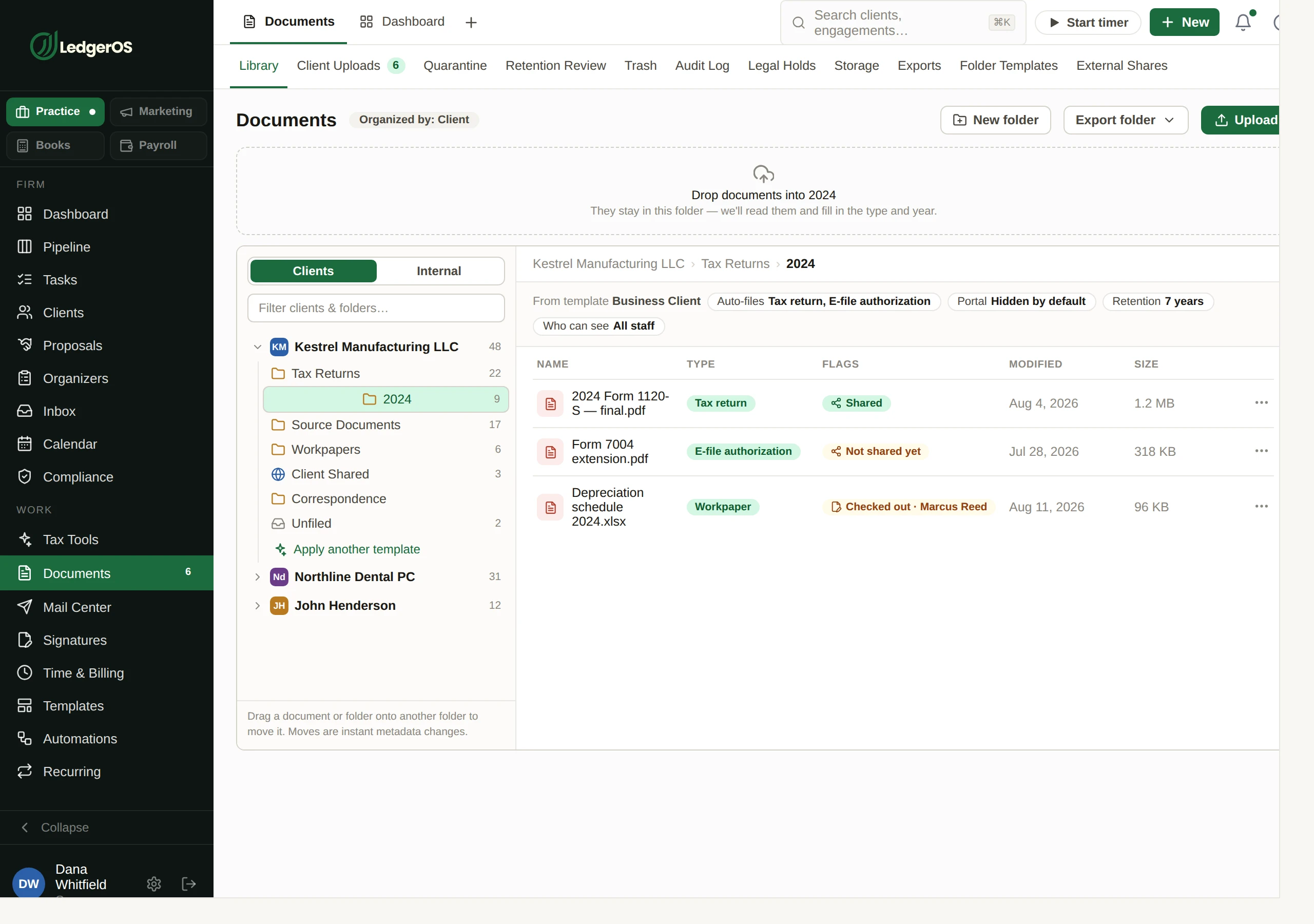
The model reads the document. Your rules decide where it goes.
When a document arrives — from your tax software’s export folder, from the portal, from a scan — a model reads it and answers one question: what is this, and how sure am I. That is the whole job. The folder it lands in is then computed from your own filing rules, in code, from that answer.
The split matters when the model is unsure. Because placement is deterministic and fail-closed, low confidence produces a document sitting in Unfiled with a visible count — not a 1099 filed confidently into the wrong client’s 2024 folder, where nobody looks until March.
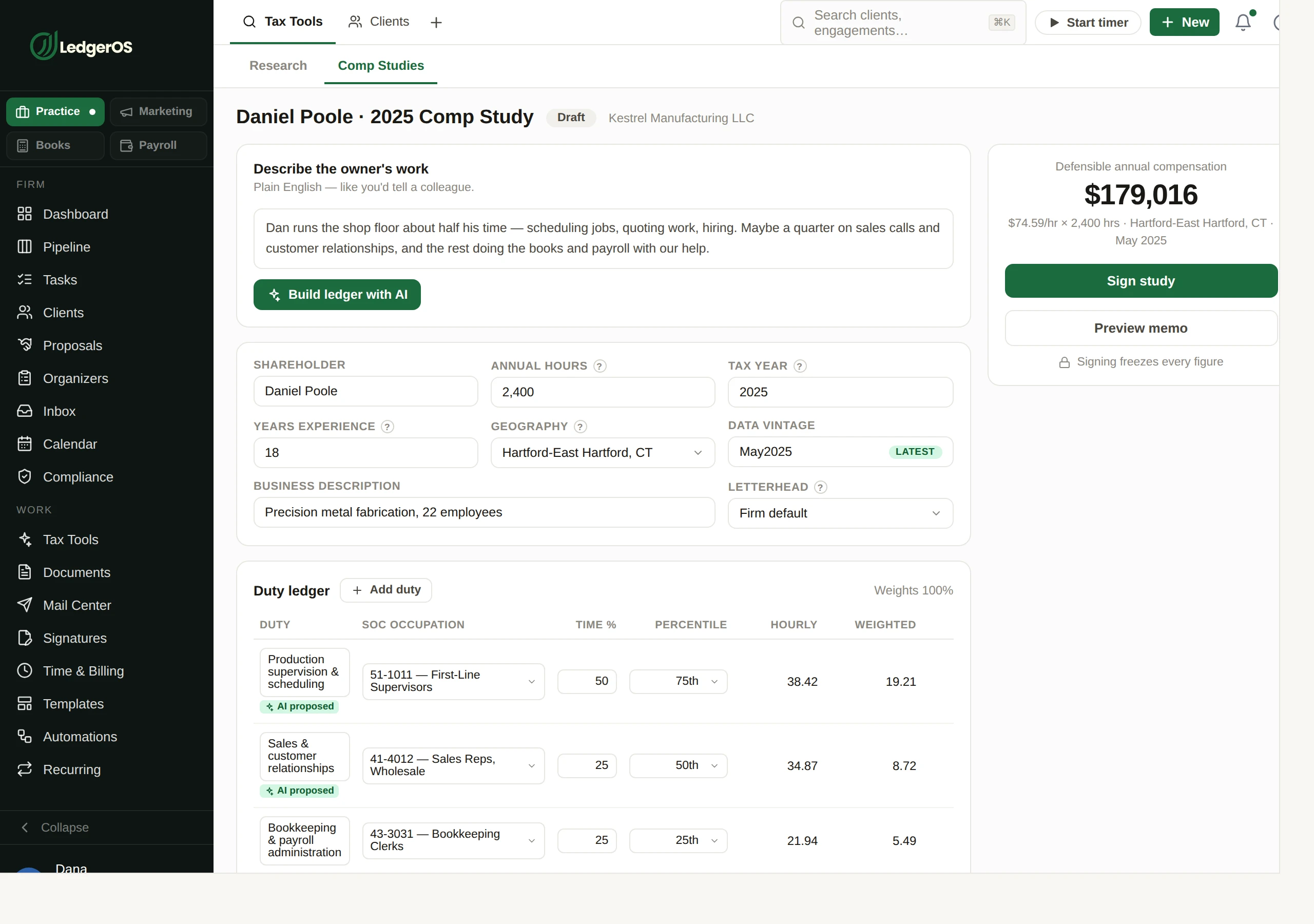
The AI proposes the duties. The wage data does the arithmetic.
Describe what the shareholder actually does and the model proposes a set of duties, each matched to an SOC occupation code. You correct them — that is the point of the step. Then the number comes from published wage data for the survey year and the metro area, at the percentile you choose per duty, weighted by the share of time.
The output is a memo you sign, showing the duties, the codes, the percentiles and the arithmetic. A defensible study is one whose reasoning somebody else can follow — not a figure a model produced.
Why you can put your name on the output
Four guardrails, enforced in the code rather than promised in a tone of voice. They are what makes the rest of this page usable on a real return.
Your filing rules decide where a document goes
The model says what a document is; your folder rules put it there, in code. When the model is unsure the document waits in Unfiled with a count on it, so an uncertain guess never becomes a filed document you have to go find later.
A person places every signature field
On a captured signature set the model names which form is on each page and how confident it is, which is the tedious part. Placing the fields and sending the packet stay with whoever is responsible for it.
Answers come only from authority you can cite
Research reads an allow-list of IRS and state sources, scoped to the jurisdictions in play. Nothing outside that list can reach an answer, so what comes back is something you can put in a memo and stand behind.
Every citation says whether we checked it
A citation we fetched and re-read is marked verified. One we could not reach says so, and says to confirm it first. You always know which parts of an answer have been checked and which are still yours to check.
Tax research, document intelligence and comp studies are three of 18 modules, all on the one $129 seat.
See every moduleReady to retire the stack?
One plan for the whole practice — $129 per seat, every Practice module included. Start your free trial today; migration support from your current tools comes standard.
14-day free trial · No credit card required · Cancel anytime