All 18 modules
Work

Documents

The archive is where firms quietly lose hours — to filing, to re-filing, to hunting for the version somebody emailed. Point an agent at the folders your tax software prints into and filing stops being a job. What lands is versioned, deduplicated, and findable by searching inside it.

The LedgerOS document library, listing filed client documents with their year, type and version.

What it does

  • An agent files what your tax software exports, by the folder it came from
  • Anything it cannot place waits in one queue with a suggested client, rather than being filed somewhere plausible
  • Nothing overwrites anything — a new version is a new version
  • Full-text search inside the documents, not just across their names
  • Retention, legal holds, and a full export whenever you want one

How it works

It knows whose document it is from where it landed

Point the agent at the folders your tax software prints into. The path is the answer: it walks up to the nearest folder it knows belongs to a client, then reads what is underneath against your own rules. An archive that is already organized stays organized, and one pass over an old export is how ten years of history comes across.

  • Subfolder rules understand year tokens, so "Tax/2026" files to the right year
  • Content-hash dedup catches the same file captured twice
  • Works with Drake, Lacerte, ProSeries, UltraTax CS and CCH Axcess exports — it needs nothing from your tax vendor
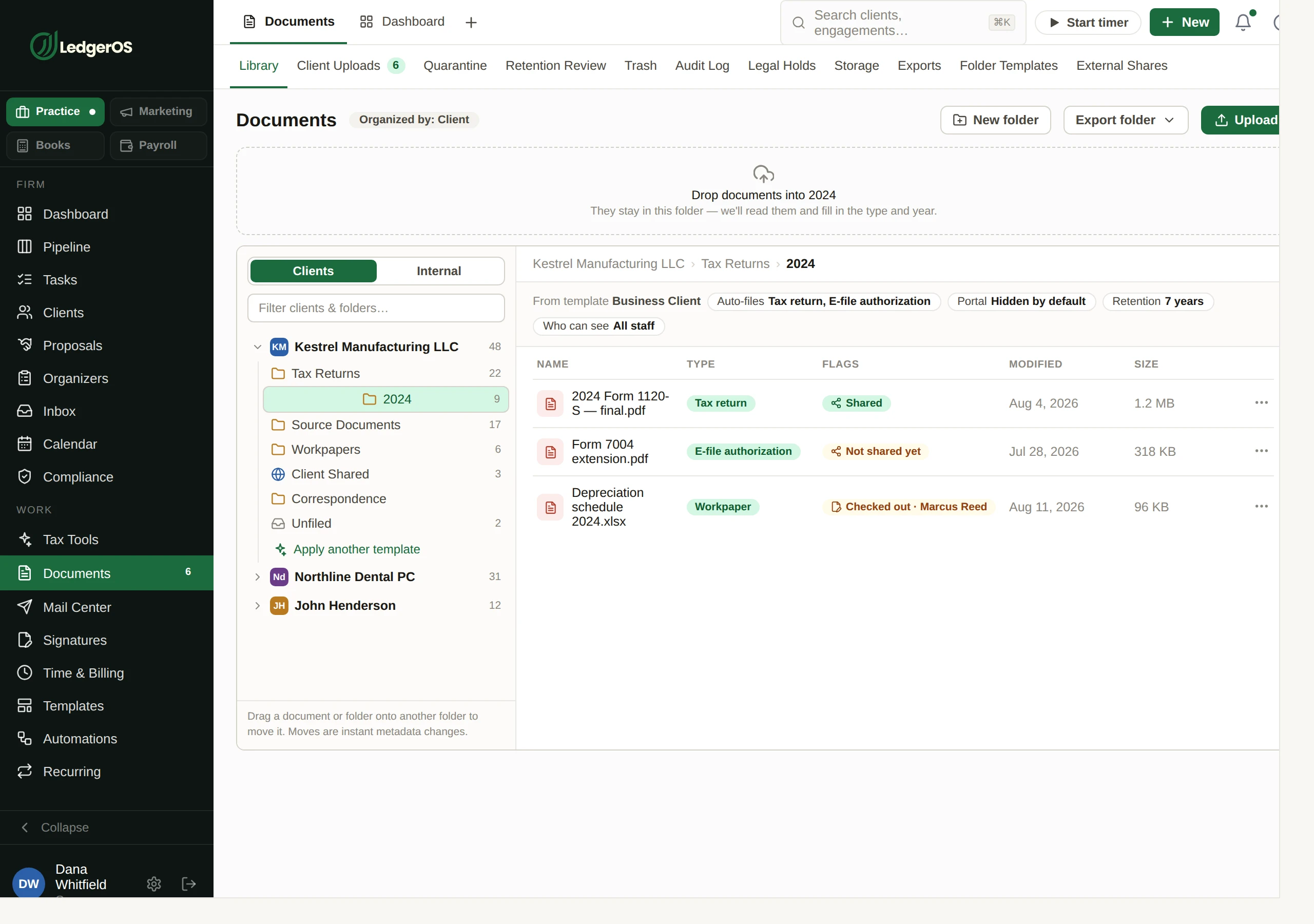
The LedgerOS document library, listing filed client documents with their year, type and version.

A model reads it. Your rules file it.

The model answers one question — what is this, and how sure am I. Where it goes is your filing rules, in code. Because those are separate, an uncertain document lands in Unfiled with a count on it instead of being confidently put somewhere wrong, which is the failure you would never find.

Unfiled is a queue somebody can actually clear

A document waiting tells you what it is waiting for. Needs a folder, needs a look because the scan was unsure, might be a duplicate — three different problems with three different answers, not one pile of nagging you learn to ignore.

You cannot lose the previous version

Replacing a file adds a version and moves the pointer; the old one is still there, and the write is on the record. Check a document out and everyone can see who has it. A filed document that has been locked will not be quietly replaced — somebody has to mean it.

Keep what you must, and leave whenever you like

Retention runs off the folder template, so returns and correspondence do not have to be kept for the same seven years. A legal hold beats retention. And an export hands you the archive plus a manifest accounting for every single file you asked for — in the box, or listed with the reason it is not. Your data was never hostage.

  • Quarantine, retention review, legal holds, audit log and external shares each have their own view
  • Trash restores rather than being a euphemism for deleted
  • The export manifest has no silent-drop path: every selected document is accounted for

Two minutes inside Documents

Questions

Does the agent need an integration with our tax software?
No. It watches folders on disk, so it works with any product that can export to one.
What if the AI gets the document type wrong?
It proposes a type; your rules decide the folder. A wrong type is corrected on the document, and low confidence lands it in Unfiled rather than filing it anyway.

Next: Mail CenterCertified mail without the trip to the post office.

Read on →

Ready to retire the stack?

One plan for the whole practice — $129 per seat, every Practice module included. Start your free trial today; migration support from your current tools comes standard.

14-day free trial · No credit card required · Cancel anytime